Monday, May 7, 2007

Cases - That Will Make You Squeamish


The Civil War was fought, "at the end of the medical Middle Ages." claimed the Union Army Surgeon General.

Little was known about what caused disease. Little was done to stop disease from spreading. There were few cures for disease, so doctors turned to folk medicine or bloodletting. Surgical techniques were barbaric and many surgeons were barely competent. Civil War soldier's chances of not surviving the war were roughly one in four. These fallen men were cared for by underqualifled, understaffed, and undersupplied medical corps. Sometimes the very means used to keep the men from suffering caused their very death.

Deaths from Chloroform...


CASE 1236.--Private G. Budlinger, 76th Ohio, aged 30 years, admitted into hospital of 1st division, Fifteenth Corps, with a shot wound of hand; placed upon operation table and about a drachm of chloroform sprinkled upon four folds of patent lint applied to face, space being given for the free admission of air. After breathing it for a few moments quietly without any apparent effect, more chloroform was added and reapplied by a nurse in attendance (the surgeon having stepped aside for a moment), when, after six or seven respirations, the patient drew up his legs and arms convulsively, and heavy stertorous breathing came on. Chloroform removed immediately, and a few moments given him to resume his regular breathing, but the difficulty increased; frothy exudation from mouth,excess of saliva; respiration became more and more incomplete, pulse small and imperceptible, veins of neck and face prominently distended; heart action ceased before respiration had entirely stopped. Friction to extremities, cold water dashed in face, jugular vein opened, artificial respiration, without relief. The surgeons of the hospital reported, as the result of an autopsy, that being unable to discover any other abnormal condition, and its the absence of further evidence, it may be proper to conclude that this is a case of apoplexy induced by chloroform.

CASE 1267.--Private Francis Heward, Co. F, 1st New Jersey, was admitted into Fairfax Seminary Hospital, April 5, 1862, with a dislocation of left humerus forward and inward of a few hours' standing. Surgeon Henry A. Armstrong, 2d New York Artillery, reduced the bone without assistance. On May 6th Acting Assistant Surgeon H. W. Ducachet discovered that the bone wits again out of place in the same direction. The patient was chloroformed and reduction attempted with the heel in the axilla, but without success. On the 9th pulleys and counter-extending hands were obtained and adjusted. Chloroform was again administered, a drachm being poured upon a piece of lint about two inches square and held about three inches from his face, a towel being thrown over the head of the patient and hand of the operator, and which was removed from time to time to admit air. Some time elapsed before the muscles became relaxed, when the chloroform was removed. There was no stertorous breathing, choking, or struggling, nor was there occasion to use force to keep him down, as at the previous administration. There was, as there always is, congestion of the conjunctiva and vessels of the neck, but not as much, certainly not more, than when the chloroform was administered on the 6th. Reduction was being attempted when symptoms of asphyxia were noticed; the pulleys were instantly relaxed, the tongue drawn forward, and artificial respiration resorted to, but everything failed. No autopsy was made. The report of the case is signed by Surgeon H. A. Armstrong and Acting Ass't Surgeon H. W. Ducachet.

CASE 1275.--Private Henry S. Ware, Co. K, 38th New York, aged 23 years, was struck by a shell in the upper part of the right leg at the battle of Williamsburg, May 5, 1862, for which injury the limb was removed on the field, at the middle third of the thigh. He was admitted into the general hospital at David's Island, New York Harbor, on June 15th, and came under the care of Acting Assistant Surgeon E. B. Root on June 26th, at which time his general condition was bad. He was suffering from diarrhœa and a very large bed-sore. The wound had nearly united but the bone was denuded. The constant discharge from the stump necessitated the removal of the necrosed bone. On October 9th the patient was placed under the influence of ether and an inch of bone removed with the chain saw, and then two inches off the bone with its involucrum. During the operation the femoral artery was divided, but not much blood was lost. Altlough it was found that more of the shaft was involved, further operative interference was deemed unnecessary. The patient was removed to his bed, when severe vomiting commenced which continued to the time of his death, within seventy-two hours. The post-mortem examination showed all the viscera healthy. Surgeon S. W. Gross, U. S. V., ascribes the death to the effects of the ether superadded to the previous exhausted condition of the system. The constant vomiting and retching could not be arrested.

* Photo of Chisolm's Inhaler

Sunday, May 6, 2007

Auld Lang Syne


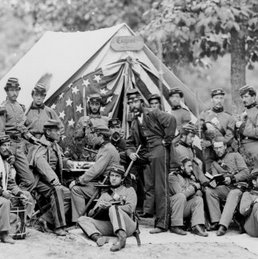
As the theater of the Civil War closed on 1861, the mudd, muck and stink of war had shown it's bloody face. Those who had thought the hostilities would only last a few short months were disheartened. The Confederates had driven back the mighty fighting force of the North. First at Bull Run, where Willis Gorman became the most hated officer in the army as the 1st Minnesota suffered the highest loss of any regiment. Followed by another depressing defeat at Ball's Bluff to the rallying cry of 'Remember Ellsworth' by the retreating Union troops! Many were dead, wounded or taken captive by the Secesh.
The Iron Brigade would have more battles to wage with the return of spring when the fighting camgaign resumed. Many units remained camped on Capital Hill in defense of the Capital. Others marched up the Potomac River. Winter quarters were being set up near Edward's Ferry, a cardinal crossing on the Potomoc in Maryland.
Most of the units had not yet been paid for services rendered. Complaints of hard grub were commonly heard until the funds finally arrived.
Kentucky had declared herself for the Union. Confederate General Polk had invaded the state and now occupied Columbus. General Grant moved forces to control Paducah, the stragtic spot at the mouth of both the Cumberland and the Tennessee Rivers.
It was heard that Edwin M. Stanton would be replacing Simon Cameron as secretary of war. The word was that Jackson's troops were still on the move.

Saturday, May 5, 2007

George W. Rinehimer


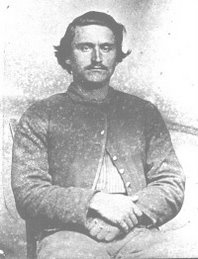
George Wesley Rinehimer was born in Hanover, Pennsylvania on September 29th in 1847. The younger brother of Emmanuel Rinehimer and brother-in-law to Daniel Porchet. He enlisted as a private in Company A, 141st Illinois Infantry on June 16th, 1864. Departed for the field on June 27th, 1864. Moved to Columbus, Kentucky and garrison duty. This regiment did not have a band. It lost 21 members by disease. Mustered out on October 10, 1864.

Thursday, May 3, 2007

Wright Family Prayer


There is nothing purer than honesty, nothing sweeter than charity, nothing warmer than love, nothing richer than wisdom, nothing more steadfast than faith. Those united in one mind form the purest, the sweetest, the warmest, the richest, the brightest and the most steadfast happiness. Here is some advice also, youth of the Wright clan; that has been taught for years to the youth of the Wright clan; be this they simple plan, Serve God and love they brother man. Forget not in temptation's hour that sin lends sorrow double power. Count life a state upon they way, and follow conscience, come that may, alike with Heaven and Earth sincere, with hand and brow and bosom clear, Fear God and know no other fear. May we of later years emulate the kindly spirit of our forefathers, and keep their precepts, thus doing them honor, and cheering on the world in its struggle of life, as well. We bless God that among the possibilities of humanity is a grand old age. Old men have blessed the world in all generations. They have blessed the secular world, and it has been so in the religious world as well. It was the aged Saint John who wrote the book of Revelation, by means of which we, receive our highest conceptions of heaven. Do not say I must do so and so, just go and do it, and come back and say it is done. Do not put off till tomorrow what you can do today. Always be kind to all whom you meet. The bravest of men are the most tender hearted. Love God and fear no man. Sometimes the sun seems to hang in the western horizon for half an hour, only just to show how glorious it can be. The day is done, the heat of shinning is over, and the beauty of the western skies baffle description. So God seems to let some of his people linger in the west after their work is done, that men may look on them and see how beautiful they are. Some are lingering there now; do you behold their beauty, shining out though Christ Jesus?
Rev. Fred Wright

The Wright Cousins


Reuben Wright was born in Steuben County, New York. He moved with his family to Wisconsin. He was proud to say he was one of the first in line to answer President Lincoln's call for 75,000 volunteers. He enlisted April 18th, 1861 as a private in Company B, 2nd Infantry Regimentat Madison, Wisconsin. The unit was mustered in June 11th, 1861. The 2nd Infantry was attached to Sherman's Brigade in Taylor's Division of McDowell's Army stationed at Fort Corcoran. Rendered service in the advance on Manassas, July 16-21, 1861 and the occupation of Fairfax Court House July 17th. Saw action at Blackburn's Ford on July 18th. Fought in the Battle of Bull Run on July 21th. Served in defenses of Washington. Promoted to Full Corporal. Discharged due to disability January 4th, 1863.

Rueben's cousin John B Wright, of Mauston, Wisconsin enlisted on October 3rd, 1861
and served as a Sergeant in Company I, 8th Infantry Regiment.
He was wounded at the Battle of Corinth in Mississippi and mustered out Company I, on September 16th in 1864.

His other cousin,Orin L. Wright, from Mackford, Wisconsin enlisted on August 31th, 1864 as a private in Company M, 1st Heavy Artillery Regiment. Discharged due to disability on January 28th, 1865.

Lambert Wright , from Mackford, Wisconsin enlisted on January 2nd, 1864 in Company I, 3rd Infantry Regiment. He was absent from Company I due to illness and mustered out on July 18th, 1865.

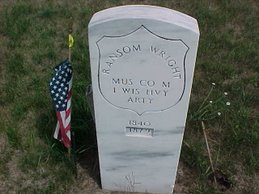
Another one of the cousins from Mackford was my GGG-Grandfather, Ransom K Wright. He enlisted on August 31st in 1864 and served as a drummer boy in Company M, 1st Heavy Artillery Regiment. Mustered out on June 26th in 1865.
His parents were R. G. and Clarissa A. Wright from New York. He had a little brother named Randolph who was too young to fight. Ransom lied about his age just to get into the army and serve alongside his older cousins. Ransom caught tuberculious during the war, possibly from his cousin Lambert who was very ill with some disease. Ransom survived the war, married and had a child before succumbing to the disease.
My Grandfather was named after him.

Wednesday, May 2, 2007

Old Fashion Turtle Soup


There's an ole coonhound running round camp today. It turns out that pup cornered us boys a big snapping turtle. A larger one I have never seen in all my life. The boys yelled to put it in the cook pot. One of the farm boys in our group said he'd fix the turtle up right fine after scalding! He layed it on its back used his Bowie knife on it after it came up out of the pot. Another one of the boys wished to keep the turtle shell as a sovereign. The cook then steeped the turtle parts in spring water while cutting up an onion and some potatoes to throw into the pot, along with a bit of flour and lard. The pot was then left to simmer while we went about our garrison duties.

Old Fashion Turtle Soup

3/4 cup flour
turtle meat, cut
butter/lard
1 celery stalk,chopped
2 onions, minced
1 tomato, chopped
2 cloves garlic, minced
3 bay leaves
pinch of oregano
pinch of thyme
pinch of parsley, chopped
pinch of black pepper
pinch of salt
1 quart stock

Melt butter/lard in a heavy pan. Add the flour and cook, stirring frequently, until the roux is light brown. Set aside.
In pan, melt butter/lard and add turtle meat. Cook until the meat is brown. Add vegetables and herbs.

Tuesday, May 1, 2007

Hardtack Recipe

Hardtack Recipe
Hardtack was a staple issued to the Union soldiers as a daily ration during the Civil War. A biscuit made from flour and other simple ingredients. It was very similar to heavyweight soda cracker. It was square or rectangular in shape with holes. The hardtack crackers were packed into wooden crates and shipped to the camps by railroad or wagon. Sometimes the batch brought to the soldiers was already several months old. Far from bring fresh, it was often called sheet-iron or tooth dullers. Weevils infested these worm castles crates that were kept stacked outside of the tents until the rations were issued. Hardtack dipped in bacon grease or hardtack and a slice of salt pork made for a hearty meal to a hungry soldier. Salted pork fried in hardtack crumbles was called skillygallee, and it was a common meal.

Hardtack Recipe

2 cups of flour
3/4 cup water
1 tablespoon of lard
Pinch of salt

Mix the ingredients together, knead the dough, and spread the dough out flat on a baking pan. Bake for 1/2 hour at 400 degrees. Remove from oven, cut dough into squares, and punch four rows of holes into the dough. Turn dough over, return to the oven and bake another 1/2 hour. Turn oven off and leave the door closed. Remove the hardtack when cooled